FRAME
CONSERVATION AND RESTORATION
It’s commonly thought that the main purpose of a frame is simply to protect the painting. However, some artists used frames as an extension of their creative vision, considering it as an integral part of the overall composition. Likewise, frames provide context and help us understand the painting’s origin or story. Frames are often considered and valued as objects of art in their own right.
Wood is the most common material for frames. Being highly hygroscopic, changes of relative humidity and temperature make the wood frame move, stretching and contracting. These movements are one of the major causes of frames’ degradation. Pests, atmospheric pollutants, mishandling or other materials, like glues or inherent imperfections can also accelerate the damaging process.
Interventions on frame restoration
Over time, frames can accumulate dirt, grime, and other surface contaminants. We carefully clean and remove unwanted layers without compromising the original finish or patina.
Frames may experience structural issues such as loose joints, cracks, or breaks. We repair and stabilise these damages, protecting the frame’s structural integrity and preventing further deterioration.
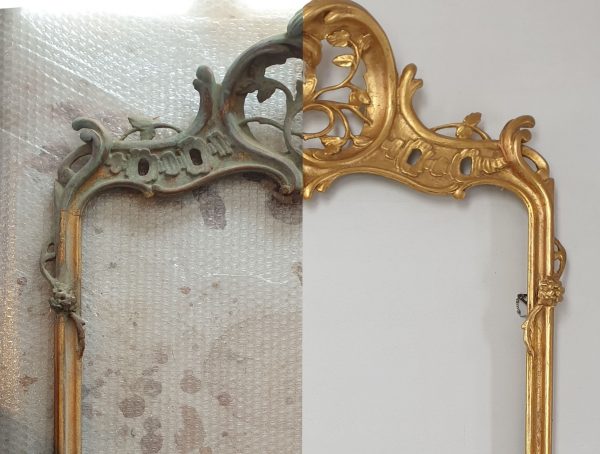
When a frame’s decorative elements, such as mouldings or ornamentation, are damaged or missing, we employ various techniques to reconstruct them.
Gilding is the decorative process of applying a thin layer of gold or gold-like material to an object’s surface. It involves various techniques and materials, such as using gold leaf with water or oil adhesives, metallic paints, and different kinds of gold leaf.
Toning is the process that involves the application of pigments or glazes, layer by layer, to adjust the gilding appearance, highlight the frame’s intricate details and achieve the desired overall effect.
Frames benefit from appropriate surface finishing and protective coatings. We apply suitable finishes to act as a protective layer, shielding the frame from environmental factors such as dust, moisture, and UV radiation.
In addition to remedial treatments, we also emphasise the importance of preventive conservation. We offer advice and guidance on proper handling, display and storage techniques to minimise risks of damage caused by environmental factors such as light, temperature, humidity or pests.
Talk to us
Have any questions? We are always open to talk about your artworks, new projects, creative opportunities and how we can help you.